|
|
|||
| VATICAN CITY -- I went down several levels of archaeological history at the tomb of St. Peter on a recent morning in search of Peter, whom we Catholics believe was the first pope. Only Peter didn't know he was pope and didn't know there was a Catholic church, either. All that would come later. The Peter of the Gospels was no great star. He was a loud-mouth braggart, and he denied Jesus in a moment of crisis. Why did the early Christians commit their devotion to one so undistinguished? Why did Christians try to make a hero out of a man who, yes, gave his life for his cause, but was really not so heroic? Why do Catholics link their respect for their leaders, a respect that often seems idolatrous to others, with such a patently unprepossessing man? | ||||
|
The answer is that we understand that it is not Peter's personal traits that attract our admiration but the power of faith that transforms an ordinary man with his ordinary human frailties into a great leader. The church, we believe, is made up of ordinary flawed human beings like ourselves who often fail or mess up and often have to apologize for our sins and failings to the One who made a flawed man his successor. The current proclivity to idolize a pope makes him different from the rest of us when in fact he is, as he himself must admit, a very ordinary person. Peter, one suspects, would be embarrassed by it all. |
|
|||
 |
Peter's successors have been ordinary. There have been mystics and wise men and great teachers and brilliant leaders (think of Gregory the Great) and saints. There have been men who rose up in the right time and the proper place to transform the church and the human condition. There also have been poltroons, liars, thieves, rapists, fools, eejits (as the Irish would say) who have messed up great opportunities or who have betrayed the church for temporal power and personal gain; traitors, who identified their own personal power with the essence of the Catholic heritage; men who seemed to have taken the vow always to do the more stupid thing; weaklings who dithered when they encountered internal or external opposition. There have been many good popes, a few great ones (Leo and Gregory, and perhaps John XXIII would measure in) and many ordinary men who tried hard, but didn't really seem to get it, and a few who seem to take all the honor heaped upon them as theirs by right and not enthusiasm for the Catholic legacy and tradition of which they are often the very inadequate sacrament. Don't tell us about the failures of popes, we say to others, we know all about them. Don't tell us about Leo X, the Medici Pope who blew the Reformation crisis (and allegedly refused the last rites) or Alexander VI, who fathered a child while he was pope. We can top those stories easily. Our faith is not in them but in God and in Jesus. Being ordinary people, we expect ordinary men in the papacy, and occasionally, we are surprised. John XXIII was one such astonishing surprise, but the men around his successors act as though he were an eejit and did almost irreparable harm to the church. They are delighted that no one is lining up to be the next Pope John. They just don't get it. John did not line up for that role either. Ordinary man that he was, he saw a rare opportunity to open a lot of windows and did so with great faith in the grace of God. |
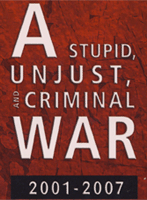 A Stupid, Unjust, And Criminal War: Iraq 2001-2007 Father Greeley calls to task those who justified, planned and executed the war and reminds us that God weeps at the destruction of war, whether lives lost are ‘ours’ or ‘theirs.’  Order
Book Read
ReviewsRead
the IntroductionLarger
Image of CoverPress
Release Order
Book Read
ReviewsRead
the IntroductionLarger
Image of CoverPress
Release |
||
|
Read Father Greeley's latest
Articles: |
||||


 Check
out
Check
out 


