|
THE
LESSONS OF HOLY WEEK
Holy Week is about the two critical issues we face -- life and death. Jesus' life and
death, our own life and death, the life and death of everyone and everything. Jesus came
to show us how to love and to live and to die. He came to explain to us the great mystery
of death, not to tell us that we would be excused from death, but that finally death would
have no power over us. He died, as
all of us must die. We all must die because he died.
However, we will all live because he lives.
Just as he rose from the dead, so shall we rise from the dead.
DENSE STUFF
These are dense, thick, headache-producing ideas. We usually
do our best not to wrestle with them. They are, nonetheless, never far away from
consciousness. Even little children become very concerned about death. The only people who
think they are immortal are teens and superannuated teens under thirty, especially
superannuated male teens (also girl teens who defy death by smoking). During Holy
Week, if we take the liturgies seriously, we cannot avoid thinking about death.
Jesus did not deserve to die. We really don't deserve to die either. Why, we might well
wonder, did God create beings who were mortal and aware of their mortality? Could he not
have made us immortal while he was at it? Or made us like our pets who live serenely
unaware of the inevitability of death?
Doesn't God seem to have behaved cruelly to
us?
Holy Week purports to provide an answer to
that mystery. Die we must because we are limited beings, but we will live again. Jesus
died so that we might live. It is difficult if not impossible to figure all of these
things out. However, he showed us how to die and
walks with us when the time comes for us to walk down into the valley of death. Jesus died
and yet he lives. So we will live again just as he does.
Even though these intricate mysteries which
lurk in the core of our existence will never be answered completely in this life, Holy
Week tells us that there is an answer and there is really good news. We will celebrate on
Easter morn because there is much to celebrate.
THE ELEMENTALS OF LIFE
During Holy Week we play with the elementals of life -- those hard core, basic things that
re the warp and woof of human existence: water, fire, light, darkness, celebration, food
and drink, friendship and love. These are some of the basic realities that sustain us and
sometimes give us hope. We need them all to live. The Church brings them into its liturgy
because they are signs of God's love and especially in Holy Week because this is the time
when his love should intrude most poignantly in our lives.
Unable to die as God, God took on human
form so that he could die with us.
SUCCESS OR FAILURE?
If we come out of our Holy Week experiences with a clearer sense that the cosmos (or
cosmoi should there be many such) is driven by love, all-consuming love, then our Holy
Week will
have been a success. If on Easter morning we are more filled with Hope that we will
conquer terror and death, then we've had a wonder-full Holy Week. If, however, the
liturgies of this holy time barely affects, then we have let one more opportunity
slip through our fingers. Eventually we won't have any opportunities left.
DID HE REALLY RISE?
Theologians like to play games with the question of whether Jesus really rose from the
dead. Some say that he did, but it was only a spiritual resurrection in the minds and
hearts of his followers. The tomb they say didn't have to be empty.
Yet which is the greater miracle, the coming back to life of one man or the return to life
of all of us?
God can bring all of us back to life, why
nitpick with him on whether he could bring one person back to life? And if he couldn't
bring one person back to life then why should be expect that some day we will arise.
As St. Paul put it, if Christ be not risen, then our faith is in vain. Those
theologians who wish to compromise with modern rationalism that says that Resurrection is
not possible are playing a losing hand from the first moment. If God can create out of
nothing, which he
surely did, why should one exclude the possibility that he can also re-create. If you can
do a Big Bang, then you can do just about anything.
The risen Jesus is not exactly the same as
Jesus before his death. We would not expect that. Exactly how he is like what he used to
be and yet still different is an interesting but
irrelevant question. Yet we cannot escape from the fact that the very earliest Christians,
aware of all the mysterious differences, still asserted that it was the same Jesus, a
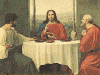
Jesus who could break bread, who could eat and drink and who could set their hearts on
fire. Theological speculations are useful, up to a point. The point arrives when
they try to explain mystery or explain it away. Holy Week does not leave us in the dark
but
dazzles us with light. |
Click Images To Enlarge
Click Images To Enlarge

Click Images To Enlarge
Click Images To Enlarge

Click Images To Enlarge
 |